Movement
The animal’s path through the video: total distance, straight-line distance and how direct or winding its route is (sinuosity).
From underwater video to energy estimates
Upload an ordinary underwater video. NICMA tracks the animal, measures how far and how fast it swims, and estimates how much energy it uses – without tags, capture or contact. Our team then helps you turn these estimates into answers about your animals and their habitat.
Request NICMA access Open NICMA app ↗What you get
The animal’s path through the video: total distance, straight-line distance and how direct or winding its route is (sinuosity).
Mean and maximum swimming speed, in metres per second and in body lengths per second, so animals of different sizes can be compared.
Estimated energy used per distance travelled, and a relative effort index that shows how hard the animal was working.
All NICMA outputs are estimates based on video analysis and model assumptions. They are not direct measurements and should be interpreted by qualified scientists in the context of each study.
Animal groups
NICMA works with any swimming animal that is clearly visible in the video and whose approximate body length is known.
Cartilaginous fish (elasmobranchs and chimaeras), including deep-sea species
Cetaceans
Sirenians
Applications
Energy use links an animal’s behaviour to the condition of its habitat. Here are the questions NICMA can help answer.
Example from our Red Sea project
In our Red Sea project, blue-spotted rays moved and used energy differently in seagrass, sand and coral habitats. The same approach can compare animals on restored and natural reefs, or on the same reef before and after restoration – giving restoration projects an additional, non-invasive indicator of how the habitat is recovering.
Compare how animals move and use energy on restored and natural reef sites, and follow the changes over time.
Track changes in how animals use a reef or seagrass bed as the habitat improves or declines.
Compare animal behaviour and energy use inside and outside protected areas to support evaluations of their effectiveness.
Shifts in movement and energy use may show that animals are under stress before population declines become visible.
Monitor activity and effort of animals in tanks and farms without handling them.
These are research applications. NICMA provides estimates that complement standard ecological surveys; it does not replace them.
Discuss your projectUpload your video and let NICMA do the analysis.
Phase 1 outputs (automatic and approximate):
NICMA’s research and consultancy team builds on the software outputs to give them ecological meaning.
In Phase 3, NICMA supports real-world applications by combining:
Final outputs:
NICMA in action
These examples show how NICMA follows an animal in an underwater video and estimates its movement and energy use. They are demonstrations of the workflow, not study results.
Rhincodon typus
Video: © Sara Asadi Gharabaghi
Movement tracking of a large filter feeder swimming near the surface.
Gymnura sp.
Video: © Faisal Aljarkas, used with permission
Tracking of a butterfly ray moving close to the seabed.
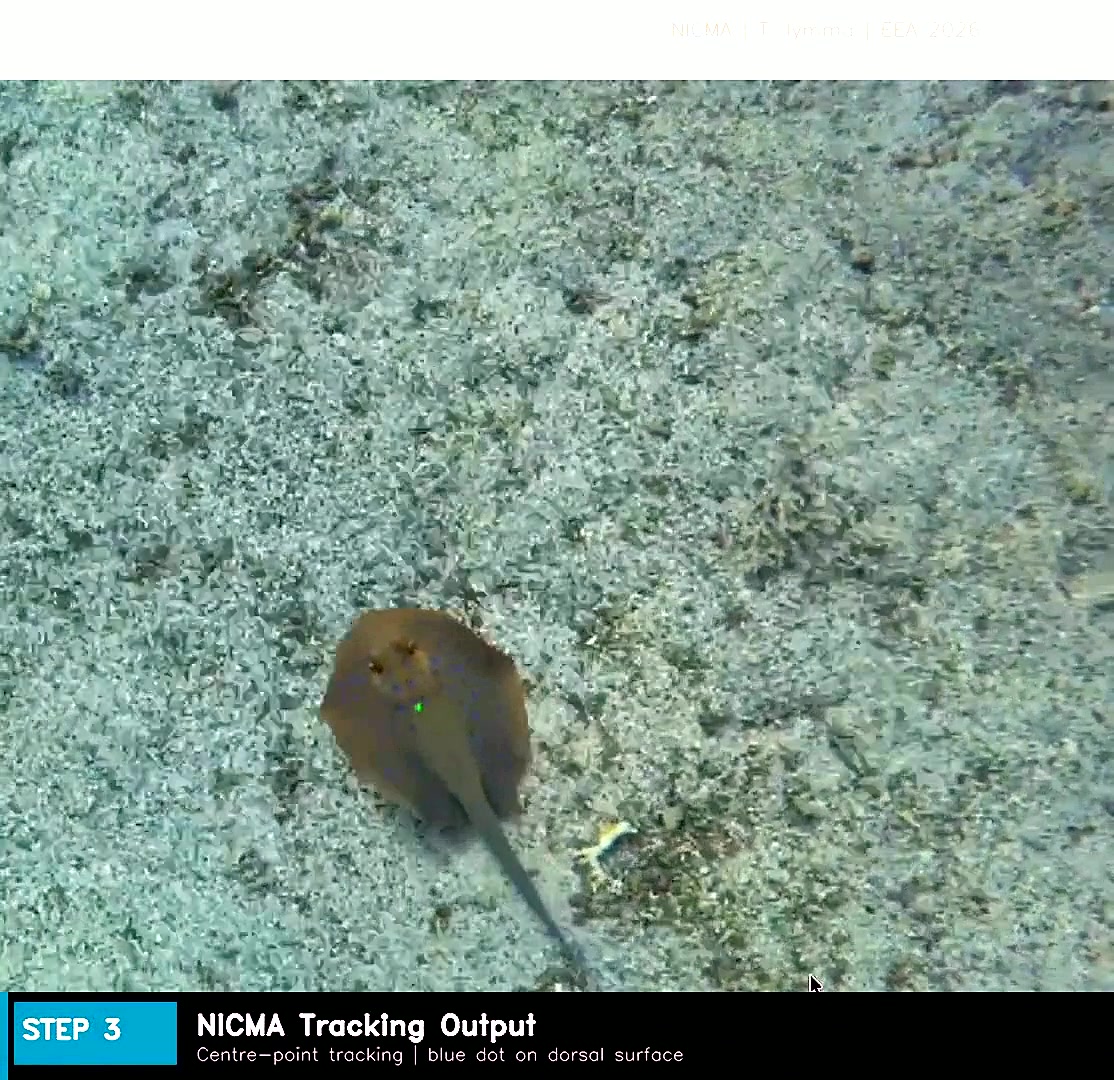
Taeniura lymma · Red Sea, Egypt
Video: © Sara Asadi Gharabaghi
Movement tracking from the NICMA study of rays in three habitats near Marsa Alam.
All NICMA outputs are estimates based on video analysis and model assumptions. They are not direct measurements and should be interpreted by qualified scientists in the context of each study.
NICMA is designed to be simple, practical and usable at every level of experience.
Contact our team at nicma.team@gmail.com to request NICMA access. After approval, you will receive secure login details and upload instructions.
Upload a video of any marine animal – for example a shark, ray, sea turtle or dugong – through our secure upload portal.
For best results:
When uploading, please provide:
This information allows NICMA to estimate distance, speed and energy expenditure.
NICMA tracks the animal, reconstructs its path and estimates:
Most analyses finish within minutes.
You receive a downloadable summary file with the movement metrics and energy estimates, for use in scientific, educational and conservation work together with expert interpretation.
All NICMA outputs are estimates based on video analysis and model assumptions. They are not direct measurements and should be interpreted by qualified scientists in the context of each study.
Request NICMA access